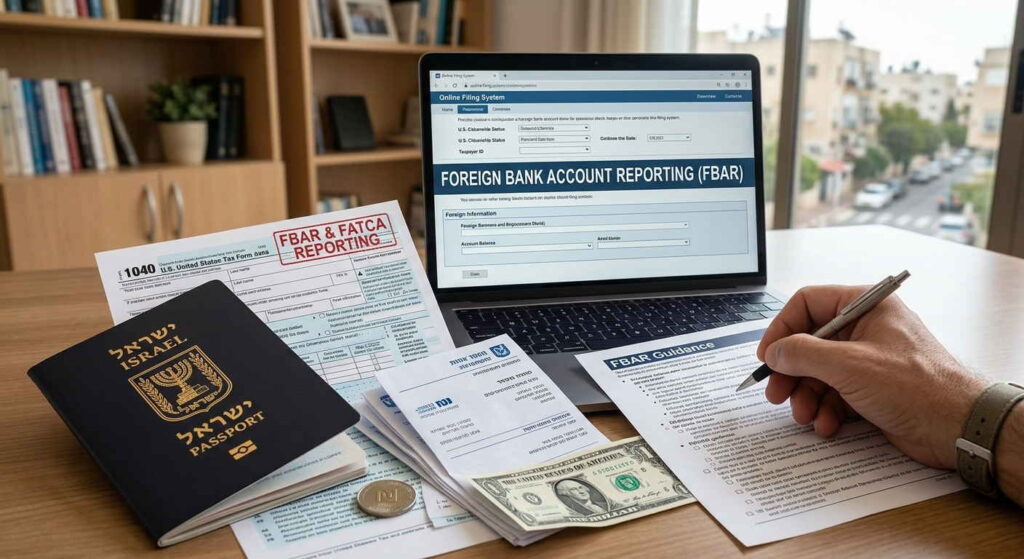
If you hold US citizenship or a Green Card and live in Israel, you have likely heard the acronyms FBAR and FATCA. These are two particularly strict US tax regulations designed to prevent tax evasion by US citizens holding accounts and assets outside the United States.
Misunderstanding or ignoring these reporting obligations can lead to severe financial penalties and even criminal sanctions. In this article, we break down the key differences between FBAR and FATCA: who is required to report, which assets are included, and how to stay compliant without running afoul of the IRS (Internal Revenue Service).
What is FBAR? (Foreign Bank and Financial Accounts)
The FBAR requirement (officially filed via FinCEN Form 114) is an established law aimed at tracking capital held by US persons in foreign financial accounts (from a US perspective, an account in Israel is considered foreign).
Who is required to file an FBAR?
Any “US Person” (citizen, resident, Green Card holder, or US entity) with a financial interest in or signature authority over financial accounts located outside the US, provided the aggregate maximum value of all foreign accounts exceeds $10,000 at any point during the calendar year.
Crucial to understand: The $10,000 threshold applies to the total aggregate balance of all accounts combined, not per individual account. If you hold three foreign accounts with $4,000 each at any point during the year (totaling $12,000), you are legally obligated to report all three accounts.
Which accounts and assets must be reported on the FBAR?
-
- Checking, savings, and deposit accounts at Israeli or foreign banks.
-
- Investment and brokerage accounts.
-
- Provident funds (Kupot Gemel), advanced study funds (Keren Hishtalmut), and executive insurance policies.
-
- Pension funds (including mandatory pensions).
-
- Accounts over which you hold signature authority (e.g., a parent’s account or a corporate account where you are a signatory), even if you do not own the funds.
What is FATCA? (Foreign Account Tax Compliance Act)
FATCA is a modern, aggressive legislative framework introduced to combat offshore tax evasion. Under FATCA regulations, Israeli banks and financial institutions report directly to the IRS regarding accounts held by US taxpayers.
In parallel to institutional reporting by financial entities, taxpayers bear an individual reporting obligation via Form 8938 (Statement of Specified Foreign Financial Assets), which is attached directly to the annual individual income tax return (Form 1040).
Who is required to report under FATCA (Form 8938)?
Reporting obligations apply to taxpayers holding specified foreign financial assets above statutory threshold amounts, which vary based on tax filing status and country of residence:
-
- For US citizens residing abroad (e.g., in Israel):
-
- Single / Married Filing Separately: Total value of foreign assets exceeds $200,000 on the last day of the tax year, or $300,000 at any point during the tax year.
-
- Married Filing Jointly: Total value of foreign assets exceeds $400,000 on the last day of the tax year, or $600,000 at any point during the tax year.
-
- For US citizens residing abroad (e.g., in Israel):
Quick Comparison Table: FBAR vs. FATCA
| Feature | FBAR (FinCEN Form 114) | FATCA (Form 8938) |
| Filing Recipient | Financial Crimes Enforcement Network (FinCEN) | Internal Revenue Service (IRS) |
| Submission Method | Online via FinCEN portal, separate from income tax return | Attached directly to annual Form 1040 income tax return |
| Reporting Threshold (Expat Status) | Exceeds $10,000 (aggregate total across all accounts) | Starts at $200,000 (varies by filing status) |
| Signature Authority Included? | Yes (even if you have no financial interest) | No (beneficial ownership required) |
| Filing Deadline | April 15 (automatic extension to October 15) | Due with annual tax return (typically June 15 for expats) |
What Happens If You Fail to File? Severe Penalties Apply
Both FinCEN and the IRS enforce reporting non-compliance strictly. Penalties generally fall into two categories:
-
- Non-Willful Violations: Penalties can reach up to $10,000+ per violation/year (subject to statutory inflation adjustments and legal developments).
-
- Willful Failure to File: Classified as a serious offense. Penalties can escalate to $100,000 or 50% of the account balance (whichever is greater) for each year of non-compliance, alongside exposure to criminal prosecution.
Missed Prior Year Filings? There Is a Solution
If you recently discovered your FBAR/FATCA compliance obligations and haven’t filed in previous years, do not simply begin filing prospectively without resolving past years (commonly referred to as “Quiet Filing,” which can trigger IRS compliance reviews).
The IRS offers specialized voluntary disclosure programs, most notably the Streamlined Foreign Offshore Procedures.
This program allows eligible US taxpayers residing outside the United States who failed to file due to non-willful conduct to submit 3 years of delinquent income tax returns and 6 years of FBAR filings to achieve full tax compliance with 100% penalty relief.
The Bottom Line: Protect Your Financial Standing
The Israeli banking system routinely exchanges financial account information with the US government. The era of undisclosed offshore financial assets has ended. Accurate, professional, and timely tax compliance is the only way to safeguard your assets and secure peace of mind.
Need assistance filing your FBAR or FATCA reporting? Contact us today to evaluate your reporting requirements and ensure your filings are prepared accurately and securely.